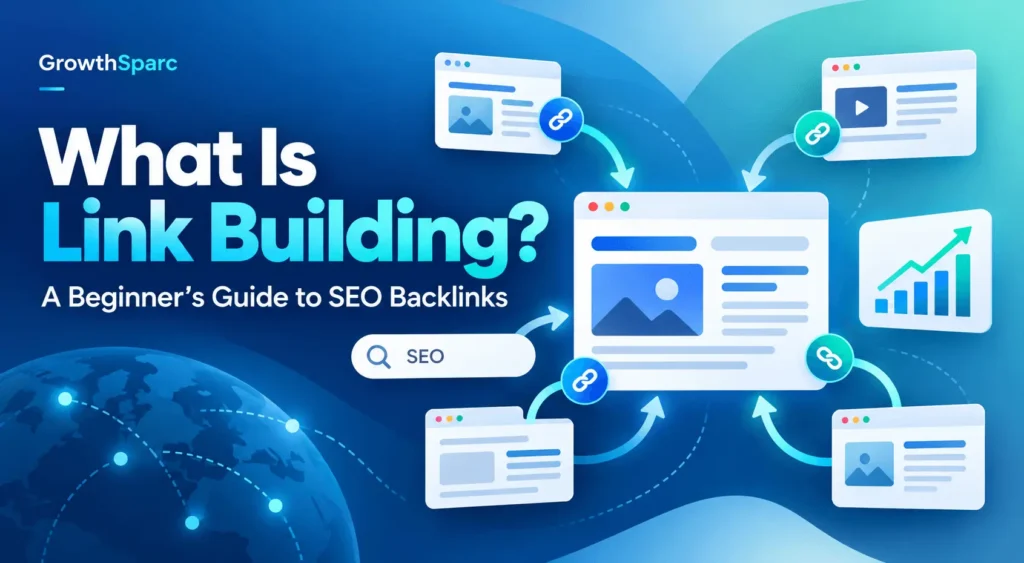
What Is Link Building in SEO?
Link building is the process of earning or acquiring hyperlinks from other websites to pages on your own website. Those incoming hyperlinks are called backlinks. Search engines can use them to discover pages and understand how content relates to the rest of the web. A link can also send real people directly to your site.
For example, suppose a bookkeeping software company publishes a genuinely useful guide to choosing accounting software. A small-business magazine cites that guide and links to it. That reference is a backlink. The goal of responsible link building is to attract links that make sense for readers, not to collect the largest possible number of links.
If you are new to SEO, remember the distinction: link building is a process; a backlink is the resulting link. Neither guarantees a particular search ranking.
Why Is Link Building Important for SEO?
Links help search engines find content and can contribute signals about relevance and reputation. They can also bring qualified referral traffic from readers who are already interested in your topic. Google explains that links are useful both for page discovery and for interpreting relevance; their impact depends on many other signals and context.
Useful links give crawlers another path to discover a page.
The surrounding topic and natural anchor text explain the linked resource.
Readers may follow a citation to learn more or evaluate a product.
A useful backlink can contribute in more than one way, but simply adding links will not fix thin content, poor site architecture, or a page that does not answer search intent. Start with content quality and a technically accessible website.
How Backlinks Work: A Simple Example
Imagine that a project-management SaaS business publishes a free comparison template. An independent productivity blog writes about planning workflows and links to that template as an optional resource. The linked page may receive direct visitors, search engines can discover it through the link, and the citation supplies relevant context.
Now compare a link placed in an unrelated casino article simply because someone accepted payment to insert an anchor phrase. The second link offers little editorial value and may create policy risk if it is intended to manipulate ranking signals. Placement context matters more than superficial metrics alone.
What Makes a Backlink High Quality?
There is no universal numerical score that guarantees a good backlink. Evaluate each opportunity with a combination of editorial relevance, page usefulness, genuine readership, placement quality, and the linking site’s trust signals.
- Topical relevance: A citation from a source discussing your industry is usually more helpful to visitors than an unrelated placement.
- Editorial reason: The author links because the destination helps substantiate a claim or gives readers a valuable next step.
- Placement: A useful citation inside an explanatory paragraph can be easier to understand than a random sitewide footer link.
- Natural anchor text: Descriptive words help users predict what they’ll find; repetitive exact-match anchors are a red flag.
- Real audience: A publication with engaged, relevant readers can be worthwhile even when third-party metrics look modest.
- Editorial integrity: An independently reviewed, well-maintained site is more credible than a network publishing anything for a fee.
Metrics such as Domain Rating and Domain Authority can support prospect evaluation, but they are third-party estimates, not Google ranking factors. Avoid treating a single metric as proof that a placement is safe or valuable.
Types of Links You Should Know
| Link type | Meaning | Typical example |
|---|---|---|
| Internal link | Connects pages on your own website | A blog guide linking to a related calculator |
| External outbound link | Points from your website to another site | A citation to official documentation |
| Backlink / inbound link | Points from another website to yours | An industry article citing your research |
| Sponsored link | A commercial link qualified with an appropriate rel attribute | A labeled paid promotion |
| UGC link | A link placed in user-generated content | A community discussion link |
The familiar words dofollow and nofollow are often used in marketing discussions, but “dofollow” is not a special HTML attribute. A regular hyperlink does not need a dofollow tag. rel="nofollow", rel="sponsored", and rel="ugc" are link attributes with distinct uses. Google’s guidance recommends appropriate qualification for paid or sponsored links; such attributes are not a substitute for genuine editorial value.
How to Start Link Building: A Beginner-Friendly Process
- Choose a page worth linking to. An original how-to guide, data-backed study, free template, practical tool, or carefully maintained resource gives another publisher a reason to cite you. Make the page accurate and easy to read before conducting outreach.
- Identify the right audience. List adjacent topics your customers read about. For a CRM company, relevant audiences could include sales operations, small business technology, and customer success—not every website that accepts guest posts.
- Research prospective pages. Look for articles where your resource answers a missing question, supports a statistic, or expands an explanation. Read the page before proposing a link.
- Check editorial fit. Assess the site’s audience, the article’s freshness, factual accuracy, and whether your proposed destination genuinely improves it.
- Write a brief, personalized pitch. Mention the specific page, explain why the resource is useful, and let the editor decide. Avoid implying that a link is owed or guaranteed.
- Record outcomes. Track the target page, contact, publication, response, editorial decision, referring URL, and referral traffic. This allows you to learn which resources and pitches resonate.
- Maintain useful resources. Update outdated information and check for broken internal links. A resource that remains trustworthy is more likely to deserve citations over time.
Five Sustainable Link Earning Methods
1. Original data and research
Publish responsibly collected findings with a clear methodology, sample details, and limitations. Journalists and subject experts may cite a useful dataset when reporting on a trend. The data needs to be substantive; a collection of unsupported numbers is not a linkable asset.
2. Helpful free tools and templates
A transparent calculator, checklist, or downloadable template can solve a recurring problem. If a free resource helps someone complete a task, relevant creators may choose to recommend it. GrowthSparc’s Backlink Cost Calculator is an example of a useful SEO planning utility.
3. Expert-led contributions
Provide an informed explanation, specialist quote, or useful example when an editor is actively covering a relevant topic. Share verifiable facts and avoid making participation contingent on a backlink.
4. Resource-page outreach
Find genuinely curated lists that serve a defined audience. Suggest your page only when it meets the curator’s stated criteria. A personalized, reader-focused recommendation is better than a bulk email blast.
5. Fixing broken references
If a topical page links to an unavailable resource and you have a credible replacement, inform the editor politely. The editorial owner should be free to accept or decline; do not manufacture broken-link opportunities or misrepresent your material.
A Simple Outreach Email Example
Subject: Small resource suggestion for your [topic] guide
Hi [First name],
I enjoyed your explanation of [specific section] in [article title]. We recently published a free [template / guide] that helps readers [clear benefit]. It may be a useful optional resource for that section.
Here is the link if you’d like to review it: [resource URL]
Either way, thanks for putting the guide together.
Best,
[Name]
Personalization is not just inserting a name. The resource should fit the editor’s page, and you should avoid sending the same generic suggestion to hundreds of unrelated sites.
Link Building Mistakes Beginners Should Avoid
- Buying links that pass ranking credit: Google considers purchasing links for ranking manipulation link spam. Paid advertising and sponsorship must be appropriately qualified.
- Excessive reciprocal exchanges: Trading links mainly to influence rankings can violate spam policies.
- Spammy automation: Mass comments, automated link placements, and low-value content networks are not a durable substitute for real coverage.
- Optimizing every anchor identically: Overusing keyword-rich anchor text looks unnatural and may make writing worse.
- Ignoring landing-page quality: Outreach cannot compensate for misleading, outdated, or difficult-to-use content.
- Confusing link counts with results: A count does not demonstrate qualified traffic, reader value, leads, or business impact.
- Sending unresearched pitches: A short, relevant proposal generally makes a more respectful request than an irrelevant mass email.
For authoritative policy details, read Google’s spam policies and guidance on qualifying commercial links.
How Do You Measure Link Building Success?
Review both outcomes and the quality of the activities that produced them. A useful monthly report could include:
- New editorial referring pages and domains, reviewed individually for relevance.
- Referral visits and meaningful on-site actions from those sources.
- Organic search impressions and clicks for relevant target pages, alongside other SEO changes.
- Relationships established with journalists, editors, or topical publishers.
- The amount of time and resources used to create and promote link-worthy assets.
If you’re comparing campaign inputs to estimated business value, try the SEO ROI Calculator and Traffic Growth Calculator. Both provide planning estimates, not predicted Google rankings. Treat correlation between links and rankings with care because content changes, competition, technical improvements, and search updates can all influence outcomes.
Link Building vs. Internal Linking
Link building usually refers to earning backlinks from other websites. Internal linking means connecting useful pages within your own website. Both help people navigate, but you control your internal links while independent publishers decide whether to link to you.
Before spending time pursuing backlinks, make sure visitors can easily find related articles, tools, and service information on your own site. For GrowthSparc readers, the Free SEO Tools hub, SEO Blog, and Link Building Services page are natural next steps depending on intent.
A Practical 30-Day Starter Plan
| When | Focus | Deliverable |
|---|---|---|
| Week 1 | Audit site and choose a useful target page | One improved or newly created resource |
| Week 2 | Research related publishers and relevant content | A small, qualified prospect list |
| Week 3 | Share tailored suggestions and respond to editors | Thoughtful outreach and relationship building |
| Week 4 | Review referrals, editorial responses and site performance | Lessons and an updated next-month plan |
This is a learning framework, not a promise to earn a fixed number of links in 30 days. In competitive niches, a single strong research asset can take substantial time to prepare and promote.
Frequently Asked Questions
Is link building still important for SEO?
Yes, links can help discovery and provide contextual signals, but no specific number of backlinks guarantees traffic or rankings. Content quality, search intent, technical accessibility, and other factors also matter.
Can beginners build backlinks for free?
Yes. Creating useful resources and suggesting them to relevant publishers does not require paying for placements, though producing content and conducting outreach takes time and effort.
How many backlinks does a new website need?
There is no universal number. Requirements and opportunities differ by niche, competitors, content quality, and search intent. Focus first on useful pages and qualified opportunities rather than an arbitrary quota.
Is guest posting link building?
Guest writing can introduce expertise to relevant readers. However, excessive guest posts primarily intended to manipulate ranking signals can violate search policies. Paid or sponsored links should be labeled with appropriate link attributes.
Are nofollow links worthless?
No. A link may still help readers find your content and generate relevant referral visits. Search engines may treat link attributes as hints, so avoid judging every link solely by a simplified “dofollow versus nofollow” label.
Does Domain Rating equal Google authority?
No. Domain Rating and comparable third-party scores are proprietary estimates. Google does not use those specific scores as ranking factors.
Can a link-building campaign hurt SEO?
Manipulative link schemes can trigger spam systems or manual actions. Follow search engine guidance, pursue genuine editorial relevance, and appropriately qualify sponsored links.
Final Takeaway
Link building is best understood as earning relevant recommendations from other websites. The foundation is something worth recommending: accurate information, firsthand expertise, useful tools, or original data. Research topical opportunities, contact publishers respectfully, and measure the real value readers receive. Prioritize sustainable editorial relationships over link volume.
When you are ready to explore professional help, review GrowthSparc’s Link Building Services or Contact page. For broader background on SEO content, read the Meta Description guide.